SohanScientificGlassWorks.com
A 500+ product borosilicate glassware catalog for a 15-year Ambala laboratory equipment manufacturer.
SohanScientificGlassWorks.com is the digital catalog for an Ambala-based manufacturer of borosilicate laboratory glassware — beakers, volumetric flasks, test tubes, measuring cylinders, round-bottom flasks, separating funnels, and reagent bottles, spanning 500+ products. The site is built to help research labs, educational institutions, and industrial buyers browse the full product range, understand specifications and standards at a glance, download the complete catalog, and request quotes directly.
A 15-year glassware manufacturer with 500+ SKUs across many near-duplicate product lines — standard versus amber-colour glass, single versus two- or three-neck flasks, narrow versus wide-mouth bottles — needed a digital presence that could represent that range clearly instead of forcing buyers to sort through it over email or phone. Buyers also search using precise technical language (glass standards, capacity ranges), which a generic catalog layout wouldn't surface well.
Designed and built the catalog site solo — the category structure, product specification display, catalog download flow, and quote request system.
Engineering challenges
Variant-Aware Category Taxonomy
Many product lines exist in multiple variants of the same underlying item — amber-colour versus clear glass, single- versus multi-neck flasks, narrow- versus wide-mouth bottles. Treating each variant as a fully separate, unrelated category would bloat navigation and make it harder for buyers to compare options within a product family.
Structured the category tree so variant lines sit alongside their base product rather than as disconnected top-level entries, keeping related options close together in navigation while still giving each variant its own dedicated listing page.
Search Visibility for Technical, Long-Tail Terms
Lab equipment buyers search using specific technical language — glass standards like ISO 3585 and ASTM E438, exact capacity ranges — rather than generic product names. A catalog structured only around product titles wasn't capturing that search intent.
Built specification and standards references directly into category and product page content and metadata, so the exact technical terms buyers search for are present on the pages that should rank for them.
Architecture
What we built
Category-Based Product Catalog
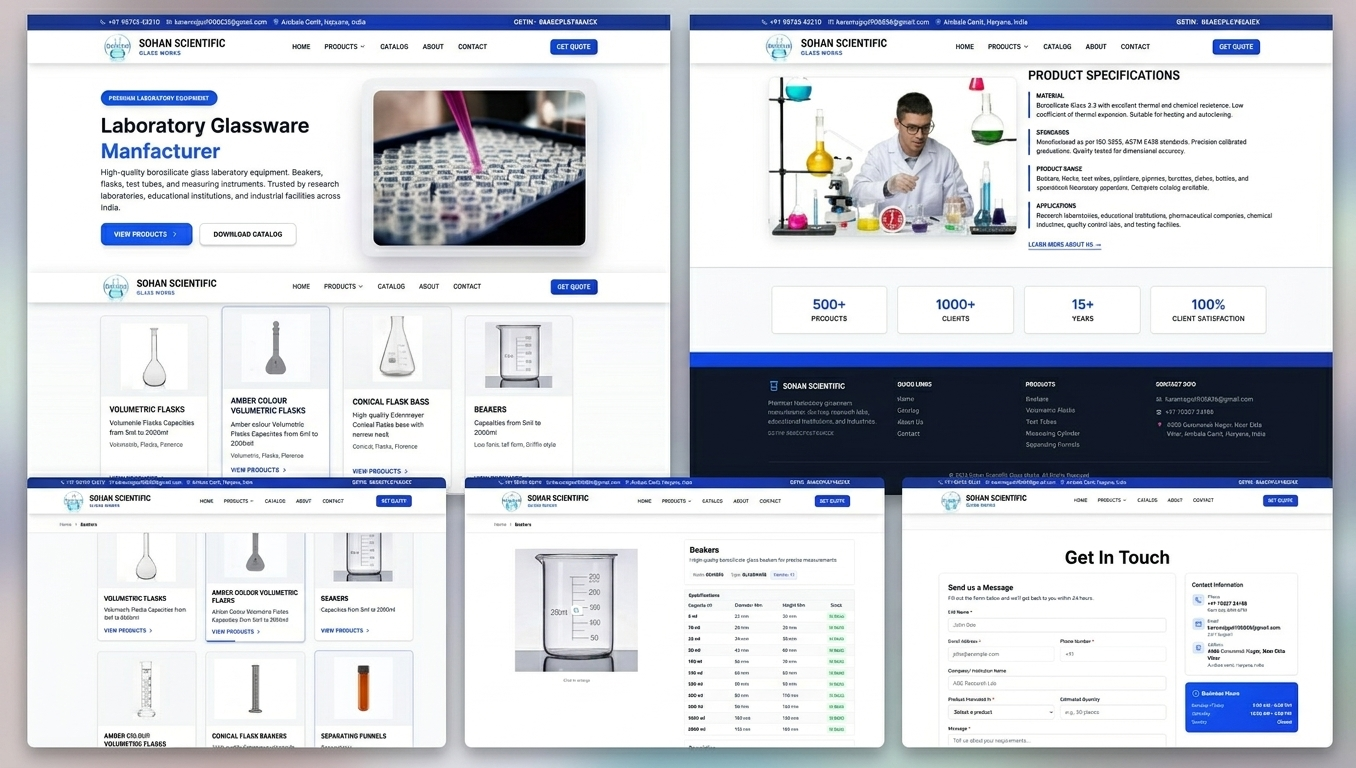
500+ products organized across 15+ categories — beakers, volumetric flasks, test tubes, measuring cylinders, round-bottom flasks, separating funnels, and reagent bottles — with amber-colour and multi-neck variants grouped alongside their base products.
Product Specification Display
Capacity ranges, material grade (Borosilicate 3.3), and manufacturing standards are presented consistently across every product listing.
Downloadable Product Catalog
Buyers can download the complete product catalog as a PDF directly from the site, without needing to request it manually.
Quote Request Flow
A dedicated "Get Quote" flow lets buyers request pricing for bulk or custom orders, separate from general browsing.
Credibility Section
Company track record — years in operation, products catalogued, and clients served — is presented upfront to build trust with new buyers.
Technical highlights
Next.js App Router with optimized image delivery across 500+ product photos
Category taxonomy that groups colour and neck-count variants with their base product line
Specification and standards content (ISO 3585, ASTM E438, capacity ranges) built into page metadata for long-tail search visibility
Separated catalog-download and quote-request flows so browsing and inquiry paths stay distinct but connected
The impact
500+
Products cataloged
15+
Product categories
Downloadable catalog
Live
Quote request flow
Business outcomes
A Digital Front Door for a 15-Year Manufacturer
Buyers can now browse the full product range and request quotes online, instead of the business relying solely on referrals and offline sales conversations.
Clearer Presentation of a Complex Product Range
Grouping variant product lines together makes it easier for buyers to compare standard, amber-colour, and multi-neck options without getting lost in a flat category list.
Lessons learned
Manufacturers with many near-duplicate SKU variants need the category taxonomy decided before content entry — retrofitting variant grouping onto an already-flat category list is expensive
A downloadable PDF catalog remains a strong trust signal for B2B buyers evaluating an unfamiliar supplier, even when the same specs already live on the page